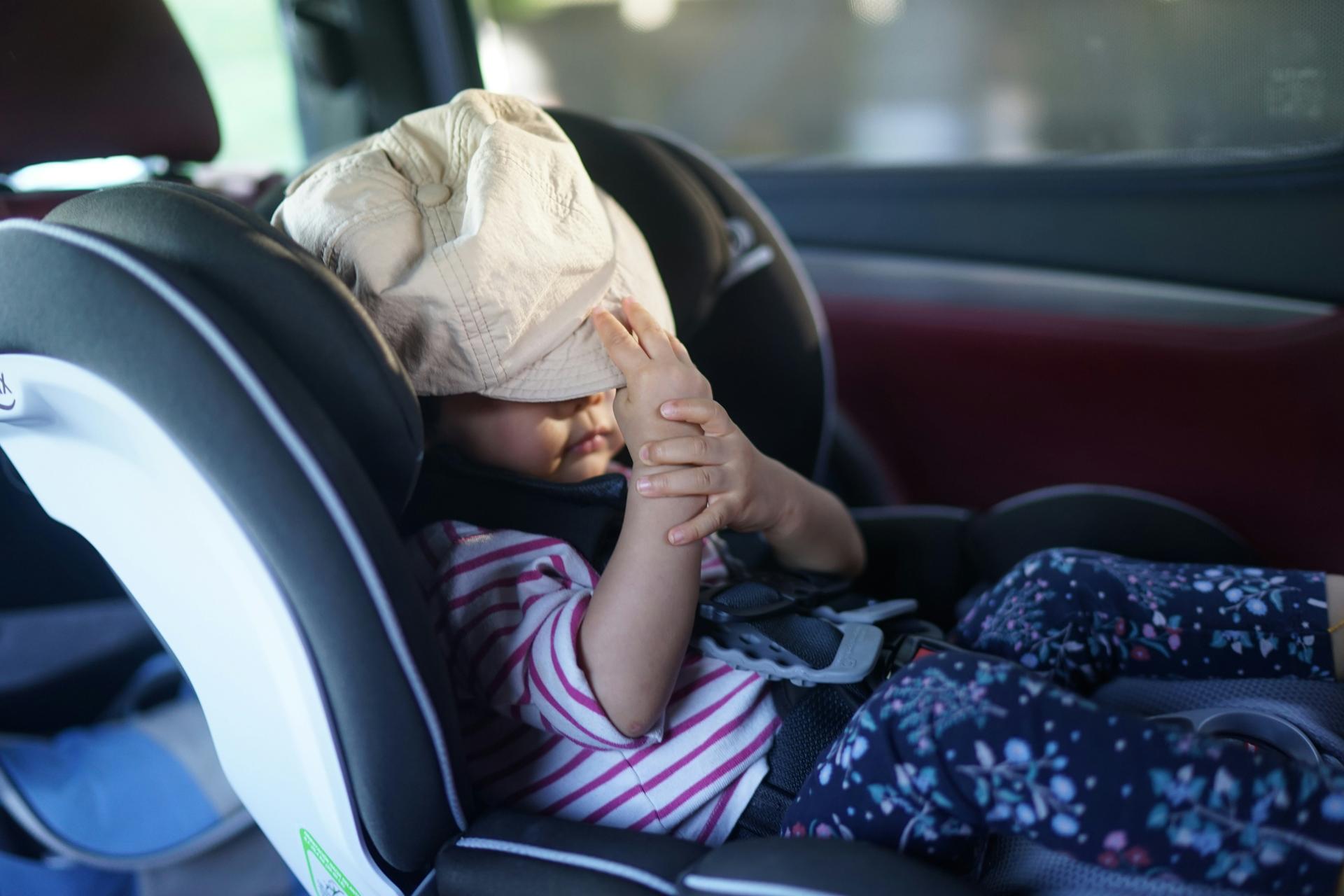
Never leave a child alone in a car.
Minimize your blind spots.
Stay up-to-date on safety models.
Keep your child the right temperature.
Don’t let kids get entangled in their seatbelts.
Teach children how to get out in an emergency.
Cars can be a dangerous place for children, but with safety gear, up-to-date vehicle models, and a watchful eye, you can minimize the risk to your most precious cargo.
Read on to discover some handy tips and tricks to help keep little ones safe until you reach your destination.
In this guide, you’ll learn how to keep kids safe inside your car—and how to protect any kids around or outside your vehicle.
Forgetting a child in the back of a car is dangerous, and it usually happens by accident. It’s more likely when someone changes up their routine and forgets a child is with them, or the child falls asleep in the back seat and doesn’t make a peep on arrival. The good news is, there are plenty of new solutions and gear to prevent this sort of accident!
Some car seats have the option of a sensor and Bluetooth-connected app to tell you when your baby has been sitting too long, the car is too hot or too cold, or the seat is not buckled properly.
New cars are also more likely to have rear occupant alerts. Most remind the driver to open the back door at the end of the ride if they opened it when they started their trip. Some also have ultrasonic technology that senses movement in the back seat and can trigger an alarm. Check if your car has any of these features.
There are also after-market sound systems for your car that purport to make it near impossible to walk away from small passengers, setting off the horn if the driver forgets to open the back door or push a button in the back seat. However, systems that need to be professionally installed by an auto mechanic do create an additional expense, and after-market equipment may impact your warranty.
Looking for a free, low-tech version of these solutions? Some parents who drive swear by the shoe trick: leave your left shoe in the back seat next to the child. Then when you arrive at your destination, you won’t be able to get far without remembering why you’re missing a shoe. (Not recommended if you drive stick!)
Road traffic injuries, according to UNICEF, are the leading cause of death in children and teens 5-19 around the world. Children are smaller than adults and harder to see. Kids are also more likely to be impulsive, chasing after balls, toys and other objects in the road.
It’s your job to keep your eye out for active play. Turn around before you back out and check your blind spots. The right gear might help. Blindspot mirrors, a backup camera, or a backup alarm when reversing your car can all give you and your neighbors more information when you drive.
Of course, any tool can fail, so it’s still best to walk around your car and look behind you before you put your vehicle in reverse.
Cars keep getting exciting new tech and model updates, and safety standards constantly change.
In 2024, the US Department of Transportation announced a major overhaul in how the National Highway Traffic Safety Administration tracks vehicles’ safety, starting with 2026 models. Along with five-star ratings for crash tests, the agency now notes whether vehicles have recommended safety technologies like automatic emergency braking, blind spot warning, and warnings if you veer from your lane. If you’re on the hunt for a new vehicle, you may want to use these safety guidelines to find a safer vehicle option.
Refinance to pay less on your current auto loan by refinancing with Auto Approve so you can save more for added tech or a downpayment on an upgraded vehicle. Millions qualify for a lower rate.
Get a free quote to see how much you could save.
Whether you’re on a family road trip or just doing the school pickup run, maintaining a safe temperature is key. Use the HVAC system in the car to keep it comfy. Also, keep a safety kit in your car with everything you need to handle road emergencies, including water for hot weather and blankets if the car breaks down on a cold day.
In cold months, it’s important to prevent hypothermia or frostbite. But if your little one is still in a car seat, too much bulk can make car seats less effective in a crash. Choose lightweight, warm layers like merino wool and fleece that still let the safety harness fit snugly on the body. Then after buckling in, put a blanket on top, or put your little one’s coat on backwards over the fitted harness to keep them cozy.
Never leave a child alone in a vehicle, even for just a moment. In cold weather, cars can become dangerously cold very quickly. And, when the weather warms, a car’s design creates a greenhouse effect that causes it to heat quickly, even when outside temps seem mild.
Buckle up and get comfy in a car seat that is the right size and fit for your child. The Centers for Disease Control and American Academy of Pediatrics recommend keeping your child in a rear-facing car seat as long as they fit—up to two to four years of age. Then, move to a forward-facing seat as long as they fit that—until at least age five.
Once they’ve outgrown the forward-facing seat, kids should continue to wear a booster seat until a regular seatbelt fits properly on their chest and lap. Experts agree any restraint is better than no restraint, but a 2004 report from State Farm and The Children’s Hospital of Philadelphia shows graduating to the seatbelt too early can mean a higher risk of abdominal injuries, so don’t rush! Kidsafe Australia has an easy five-step test you can conduct to see if a child is ready to say goodbye to the booster seat.
There’s another good reason to keep your child in the right seat for their size—the risk of lap belt entanglement. Children are inquisitive, and they may want to pull the seat belt all the way out to see how it works. Yikes! This is how seatbelts become risky. Most seatbelts lock into place when sharply tugged on or pulled all the way out of the retractor, and once the belt locks, the child may not be able to get out.
The right car seat can help keep curious tots away from loose seatbelts. If your child has outgrown their car seat and is now using a seatbelt, teach them that it is not a toy. If their hands need stimuli, try designating a special toy for the car that can offer a distraction. Fidget spinners, squishy balls, or a stuffy from your kid’s favorite show can all help make rides fun and safe!
The NHTSA says since 1998, more than 230 children in the United States “have died in cars after they gained access to a vehicle and became trapped.” Lock your car and trunk with the windows closed when you aren’t using it, so tiny explorers can’t jump in. And encourage your neighbors to do the same!
Cars built after 2001 have an emergency release mechanism that allows someone to open the trunk if they are trapped inside. Make sure yours works and teach your kids how to use it to escape. Younger kids might not have the strength to open the trunk from inside, so above all, teach children that cars and trunks are not for playtime.
Let’s be real – childproofing is just one of the many expenses you’re probably staring at right now. Paw Patrol themed birthday parties for Sophia, new Bluey sneakers for Grayson, Robux for little Riley’s Roblox habit… it all adds up.
Ready to spend less on your auto loan, and more on making memories with the ones you love? Find out how much you could save with just a few clicks.